A new methodology for evaluating the performance of innovation districts has been developed in Florianópolis
A partnership between the Center for Innovation, Research, Technology, and Innovation at the Federal University of Santa Catarina — InPETU hub — and DashCity is developing the Global Innovation Districts Index (IGDI), a scientific methodology designed to measure, classify, and compare innovation districts in any territorial context worldwide.
The project was launched with an ambition unprecedented in Brazil: to create a common quantitative framework capable of assessing the stage of development of innovative territories, identifying structural bottlenecks, monitoring progress over time, and comparing local ecosystems with national and international benchmarks such as, for example, 22@Barcelona, Kendall Square (MIT), One-North Singapore, and Porto Digital in Recife.
More than just a ranking, the IGDI was conceived as a strategic tool for territorial intelligence. The framework integrates economic, urban, social, academic, and governance indicators, enabling a systemic analysis of innovation territories.
“Territorial innovation can no longer be analyzed solely by the number of startups or established companies. The world’s most innovative territories are those that succeed in integrating knowledge, urban quality, human capital, governance, and social impact. The IGDI was created precisely to measure this complexity,” notes Clarissa Stefani Teixeira, director of innovation at UFSC and responsible for coordinating the partnership.
The methodology was developed by integrating scientific frameworks on knowledge-based urban development, innovation spirals, open innovation, place quality, and the evaluation of innovation ecosystems. The index is based on eight major strategic dimensions: human capital, infrastructure, business activity, research and development, economic impact, social and urban impact, territorial integration, and global connectivity. The IGDI will establish itself as a permanent technical observatory, featuring continuous data collection, public dashboards, and periodic reports on the territory’s progress.
According to Alex Lima, co-founder of Dashcity: “The IGDI gives the Northern Island Innovation District something it was missing: a rigorous way to view the territory itself as an integrated system, raising local awareness of its assets and bottlenecks. The index helps the ecosystem recognize itself, monitor its evolution, and compare itself to global benchmarks. For Dashcity, the partnership with the InPETU hub combines UFSC’s scientific expertise with our ability to transform data into predictive intelligence—building a permanent technical observatory that enables the region to clearly see and measure the positive impact of the future it can build.”
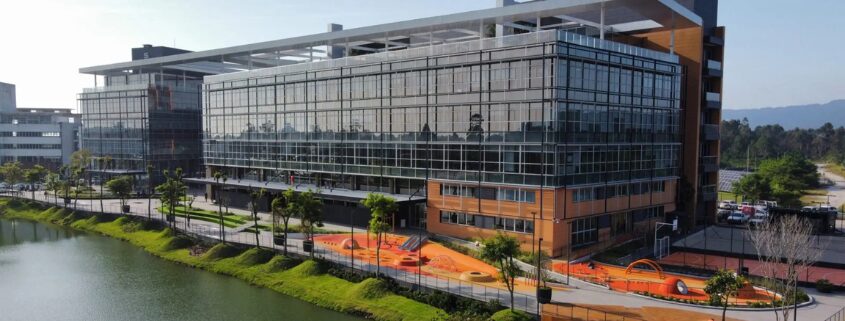
The first area where the index will be applied is the Innovation District located in the northern part of the island, in Florianópolis, with Sapiens Parque serving as the ecosystem’s main anchor facility. The initial application of the methodology classifies the territory as a “developing district,” with projected potential to reach a level of global excellence by 2035.
Starting in July 2026, the first version of the interactive platform will be available for real-world testing. Research institutions and managers of national and international innovation environments will be able to register and enter data from their territories to extract territorial intelligence and economic development indicators guided by the IGDI ranking. Those interested in receiving the access link can request it by sending an email to distrito@inpetu.ufsc.br.
About the InPETU hub
The InPETU hub—Center for Innovation, Research, Entrepreneurship, and Technology at the Federal University of Santa Catarina—is an innovation center affiliated with UFSC, located at Sapiens Parque in Florianópolis. Its mission is to promote innovation through the collective construction of knowledge, connecting universities, companies, government, and society to develop solutions with economic, social, and environmental impact. It operates in areas such as entrepreneurship, open innovation, territorial intelligence, living labs, ecosystems, pre-incubation, talent development, and innovation districts.
The InPETU hub emerged from the evolution of the former Institute of Petroleum, Energy, and Gas (InPetro), expanding its scope to different fields of knowledge related to science, technology, innovation, and entrepreneurship. The InPETU hub seeks to generate innovation and knowledge that impacts all sectors of society, with the vision of becoming a national leader in the effective integration of innovation ecosystems by 2030.
Visit the official website for more information!
About DashCity
DashCity is a Florianópolis-based startup specializing in predictive territorial intelligence. The company develops platforms, observatories, indices, and methodologies focused on territorial analysis, urban planning, innovation, economic development, and data-driven decision-making. It works with governments, companies, universities, technology parks, and innovation ecosystems to build strategies for the future of territories.
DashCity uses artificial intelligence, predictive analytics, data visualization, and proprietary methodologies to develop territorial assessments and projections. Among the projects it has developed are studies on innovation, public well-being, community development, economic behavior, and urban trends.
Visit the official website for more information!
Stay up to date with the ecosystem! Follow the Florianópolis Innovation Network on Instagram and also keep up with ACATE through its newsletter, LinkedIn, and Instagram.